Business Acumen
Seeing the Bigger Picture: Why Business Acumen Needs Blue Ocean Thinking
Most companies compete harder in the same market. The ones that grow fastest ask a different question: where's the opportunity no one's chasing yet?
20 October 2026
·Kedar — Cube Acumen Team
A business is more than a collection of departments. Sales, marketing, operations, finance, people and technology all influence one another. A decision to lower prices, for example, may increase sales but also reduce profit or put pressure on production.
Business acumen means understanding these connections: how a company serves customers, earns revenue, manages costs and uses its resources. It helps professionals look beyond their individual roles and make decisions that support the whole business. For example, a marketing campaign may generate orders, but the company must also have enough stock, staff and cash to fulfil them.

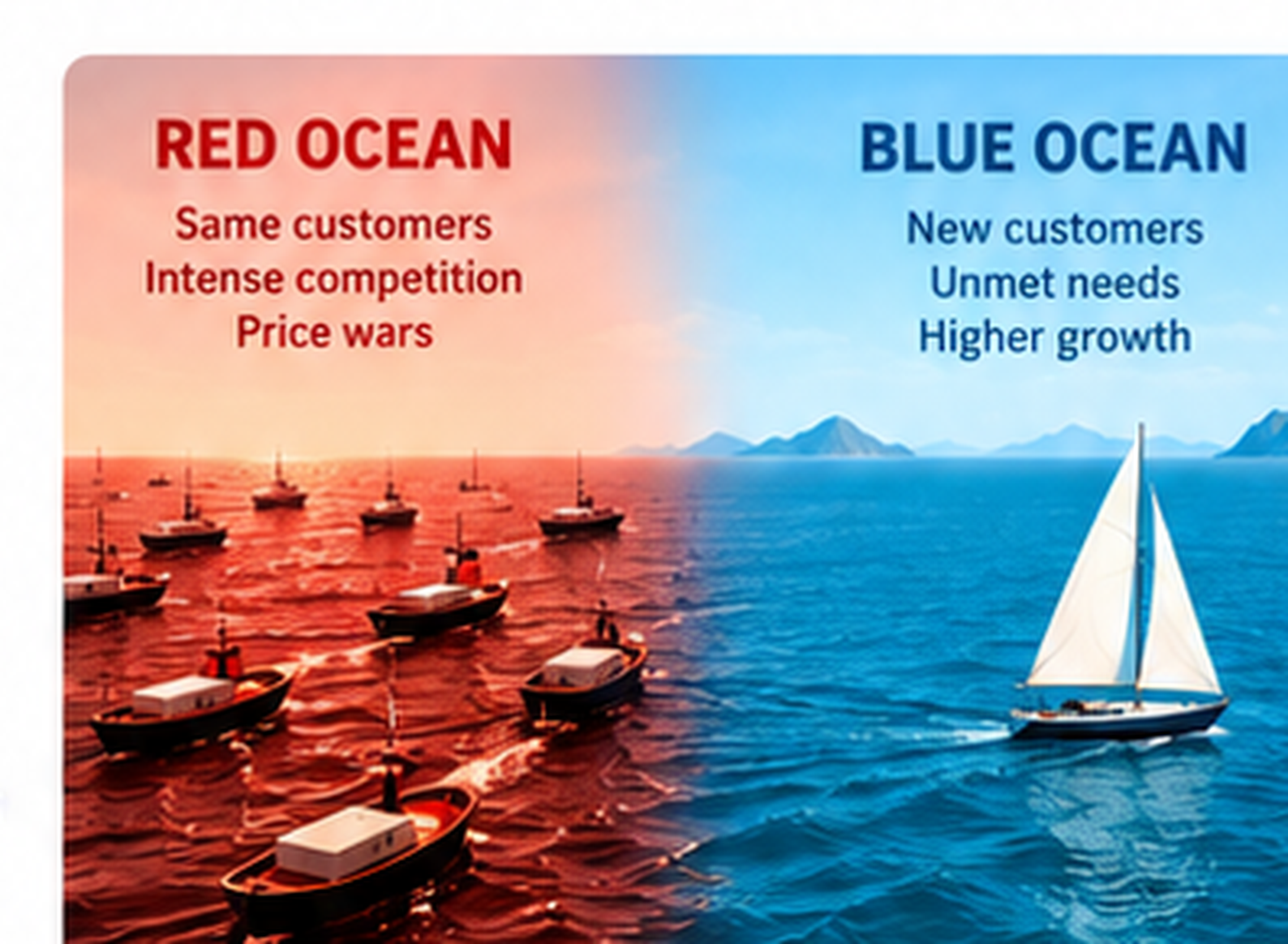
Most companies compete for customers in crowded markets. They often offer similar products, cut prices and spend more on promotion. This is sometimes called a "red ocean": a market where competition is intense.
Blue Ocean Strategy asks a different question: what do customers need that existing businesses are not providing? The answer may be a new product, a different customer group or a better way to solve a familiar problem. Instead of fighting only for existing demand, a business looks for ways to create new demand. The goal is not simply to invent something unusual. It is to offer value that customers genuinely want and that the company can deliver successfully.
Employees make stronger decisions when they understand the business impact of quality, time, costs and investment. Teams also work better together when they see how their choices affect other departments.
This broader view helps professionals adapt to changing markets, identify opportunities and contribute more confidently to company goals. It matters whether someone works in a large organisation, a small business or a growing startup. A stronger understanding of the whole business also makes conversations between departments more productive, because people can discuss shared outcomes rather than separate targets.
Entrepreneurs need both sound business judgement and a fresh view of the market. Before launching, they must ask: Who is the customer? What problem are we solving? What will it cost? How will we fund growth?
Blue Ocean thinking encourages founders to look for overlooked customers rather than simply copying competitors. Business acumen helps them check whether their idea can be delivered profitably and supported with enough cash. Neither removes business risk, but together they support better-informed choices.
Reading about business decisions is useful. Making those decisions — and seeing what happens — is a different experience. In Gravity, Cube Acumen's Business Acumen and Blue Ocean Strategy simulation, participants run a company and make connected choices about prices, marketing, production, people, investment and finance.
They see how one decision can affect customer demand, costs, profit and cash. They also explore how understanding customer needs can reveal opportunities for new products. Because the experience takes place in a simulation, learners can test ideas, learn from setbacks and improve their approach without risking a real business. As market conditions change, participants must review their results, rethink assumptions and decide what to do next. This turns financial reports and strategic ideas into practical learning.
For college students, this offers a practical introduction to how companies work. For professionals and aspiring entrepreneurs, it provides a chance to practise decisions that usually carry real financial consequences.
The key lesson is simple: business acumen helps us understand how to run a company well, while Blue Ocean Strategy helps us imagine where it could grow next. Together, they build the judgement to manage today's business and discover tomorrow's opportunities.